

Introduction
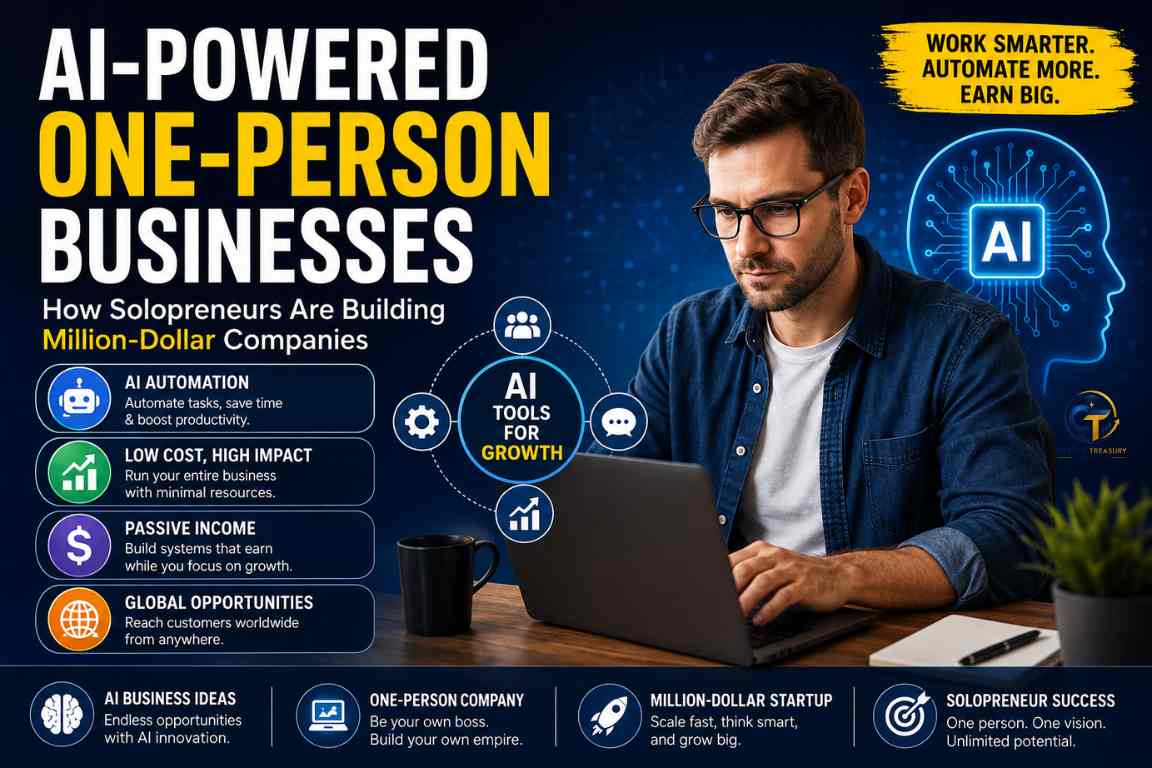
The traditional belief that successful businesses require large teams, expensive offices, and significant startup capital is rapidly changing. Thanks to artificial intelligence, a new generation of entrepreneurs is building highly profitable businesses with little more than a laptop, internet connection, and the right AI tools.
In 2026, AI-powered one-person businesses are becoming increasingly common. Solopreneurs are using artificial intelligence to automate content creation, customer support, marketing, design, research, and business operations. This shift is enabling individuals to achieve revenue levels that previously required entire teams. Recent studies and industry reports show that AI is lowering the cost of entrepreneurship and helping founders operate more efficiently.
What Is an AI-Powered One-Person Business?
An AI-powered one-person business is a company operated primarily by a single founder who uses artificial intelligence and automation tools to perform tasks traditionally handled by employees.
These businesses often use AI for:
- Content creation
- Marketing automation
- Customer service
- Data analysis
- Graphic design
- Research
- Sales support
- Workflow management
Rather than replacing human creativity and decision-making, AI acts as a digital workforce that handles repetitive and time-consuming tasks.
Why AI Is Transforming Solopreneurship
Artificial intelligence is changing entrepreneurship in several important ways.

Lower Operating Costs
In the past, entrepreneurs often needed employees, freelancers, and agencies to grow a business. AI now allows founders to complete many of these tasks themselves at a fraction of the cost. Research suggests AI is reducing startup barriers and encouraging the creation of leaner businesses.
Increased Productivity
Modern AI toolscan help entrepreneurs complete hours of work in minutes. Tasks such as writing marketing content, generating reports, analyzing data, and responding to customer inquiries can be partially automated.
Faster Business Growth
AI enables founders to test ideas quickly, launch products faster, and scale operations without significantly increasing expenses.
Infographic: How an AI-Powered One-Person Business Works
Founder
⬇
AI Research Tools
⬇
AI Content Creation
⬇
AI Marketing Automation
⬇
AI Customer Support
⬇
Digital Product or Service
⬇
Revenue Growth
⬇
Scalable One-Person Business
Infographic Data Table
| Business Function | Traditional Team | AI-Powered Solopreneur |
|---|---|---|
| Content Writing | Content Writer | AI Writing Tools |
| Graphic Design | Designer | AI Design Tools |
| Customer Support | Support Staff | AI Chatbots |
| Marketing | Marketing Team | AI Automation |
| Research | Analysts | AI Research Tools |
| Operations | Operations Team | AI Workflows |
Real Examples of AI-Powered Solopreneur Success
The rise of one-person companies is no longer theoretical. Multiple reports highlight solo founders generating significant revenue by leveraging AI and automation. Industry observers note that AI is helping narrow the gap between solo operators and larger startups.
Some entrepreneurs have built:
- Micro-SaaS businesses
- Digital product brands
- Online education platforms
- Content businesses
- AI consulting services
- Subscription-based newsletters
The common factor is not simply AI adoption but the creation of systems that allow founders to operate efficiently.
Most Profitable AI-Powered One-Person Business Models
1. AI Content Publishing
Entrepreneurs build niche websites focused on topics such as finance, business, technology, careers, and education.
Revenue sources include:
- Advertising
- Affiliate marketing
- Sponsored content
- Digital products
2. AI-Powered Consulting
Consultants use AI to:
- Generate reports
- Analyze data
- Create presentations
- Improve client communication
This allows them to serve more clients without expanding their teams.
3. Digital Products
Popular digital products include:
- E-books
- Templates
- Online courses
- Toolkits
- Business resources
Once created, these products can generate recurring revenue.
4. Micro SaaS Businesses
Micro SaaS products solve a specific problem for a niche audience. AI can accelerate development, customer support, and marketing activities.
Benefits of Running an AI-Powered One-Person Business
Greater Flexibility
Entrepreneurs can work remotely and manage their businesses from anywhere.
Higher Profit Margins
Lower staffing costs often translate into higher profitability.
Faster Execution
AI reduces the time required to complete many business activities.
Global Reach
Digital products and services can be sold worldwide.
Challenges and Risks
While the opportunities are significant, there are important challenges.
Quality Control
AI-generated content and outputs still require human review.
Competition
As AI tools become more accessible, competition is increasing.
Overreliance on Automation
Businesses that depend entirely on AI may struggle with originality and customer trust.
Human Skills Still Matter
Strategy, leadership, creativity, relationship-building, and decision-making remain essential for long-term success.
Research suggests that while AI increases entrepreneurial participation, the highest-performing businesses still benefit from strong execution and human judgment.
Best AI Tools for Solopreneurs
Popular categories include:
Content Creation
- ChatGPT
- Claude
- Gemini
Design
- Canva AI
- Adobe Firefly
Marketing
- Email automation platforms
- Social media scheduling tools
Productivity
- AI meeting assistants
- Workflow automation software
The most successful founders focus on solving customer problems rather than simply using the latest AI technology.
The Future of One-Person Companies
Industry experts increasingly believe that AI will continue reducing barriers to entrepreneurship. Studies indicate that AI is helping more individuals launch businesses and operate independently.
However, successful businesses will still require:
Conclusion
- Strong customer understanding
- Clear positioning
- Effective marketing
- Trust and credibility
- Continuous learning
The future belongs not to entrepreneurs who rely solely on AI but to those who combine AI efficiency with human expertise.
AI-powered one-person businesses represent one of the most important entrepreneurship trends of 2026. By combining automation, digital tools, and strategic thinking, solopreneurs are building companies that were once only possible with large teams.
Although AI can dramatically improve productivity, sustainable success still depends on delivering real value to customers. Entrepreneurs who use AI as a tool rather than a replacement for human judgment are likely to be best positioned for long-term growth.
Frequently Asked Questions
Can one person really run a successful business using AI?
Yes. Many solopreneurs use AI tools to automate routine tasks, allowing them to operate efficiently without large teams.
What is the best AI business model for beginners?
Content websites, digital products, affiliate marketing, and consulting services are often considered beginner-friendly options.
Does AI replace employees completely?
No. AI can automate repetitive work, but creativity, strategy, and relationship-building still require human involvement.
How much can an AI-powered one-person business earn?
Income varies depending on the niche, business model, market demand, and execution. There is no guaranteed income level.
Disclaimer
This article is for informational and educational purposes only. It should not be considered financial, investment, or business advice. Results vary based on skills, market conditions, effort, and business execution.
Sources & References
- OpenAI Small Business Research
- AI Entrepreneurship Academic Studies
- Solopreneur Industry Reports
- Digital Business and SaaS Market Research








Leave a Reply