

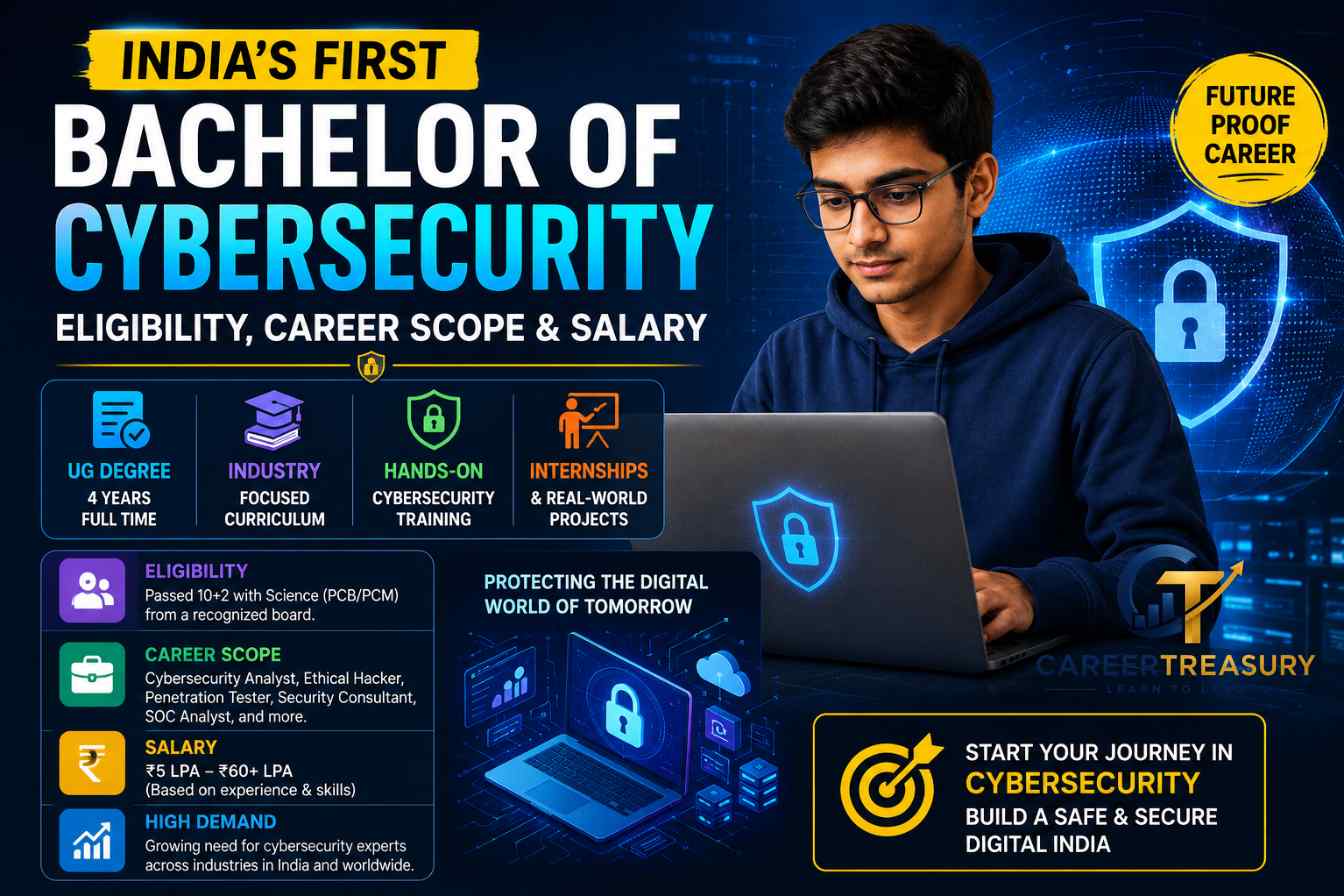
Introduction
Cybersecurity has become one of the most important fields in the digital era. As cyber threats continue to grow across banking, healthcare, government services, defense, and e-commerce, the demand for skilled cybersecurity professionals is increasing rapidly.
To address this growing need, IIT Madrasand IIT Kanpur have jointly launched India’s first practice-oriented Bachelor of Cybersecurity (B.Cyber.) program, beginning from the 2026-27 academic session. The four-year undergraduate degree combines classroom learning with practical field deployment, making it one of the most unique cybersecurity programs in the country.
This guide explains the eligibility criteria, admission process, course structure, career opportunities, salary expectations, and future scope of this emerging degree.
What is the Bachelor of Cybersecurity (B.Cyber.)?
The Bachelor of Cybersecurity (B.Cyber.) is a specialized undergraduate program designed to train students in protecting digital systems, networks, cloud infrastructure, and critical national assets from cyber threats.
Unlike traditional computer science degrees, this program focuses specifically on:
- Ethical Hacking
- Digital Forensics
- Cloud Security
- Malware Analysis
- Penetration Testing
- Network Security
- Hardware Security
- Critical Infrastructure Protection
The program is jointly offered by IIT Madras and IIT Kanpur and is described as India’s first practice-oriented bachelor’s degree in cybersecurity.
Cybersecurity Career Roadmap
12th Pass (PCM Preferred)
 ↓
Cybersecurity Admission Process
 ↓
Bachelor of Cybersecurity (4 Years)
 ↓
Hands-on Labs & Projects
 ↓
Field Deployment Experience
 ↓
Industry Certifications
 ↓
Cybersecurity Professional
Program Structure
| Phase | Focus Area |
|---|---|
| Year 1 | Computer Systems & Security Fundamentals |
| Year 2 | Networks, Cryptography & Ethical Hacking |
| Year 3 | Advanced Cybersecurity Training |
| Year 4 | Field Deployment & Real Projects |
Eligibility Criteria
Educational Qualification
Candidates must have completed Class 12 or equivalent with appropriate eligibility conditions specified by the participating institutes.
IIT Kanpur has also indicated that eligible candidates can include students from recognized boards such as NIOS.
Nationality
Only Indian nationals are eligible for admission.
Age Limit
According to official information shared during the program launch, the upper age limit is generally 25 years for admission.
Admission Process
The admission process differs from traditional engineering admissions.
Selection Criteria
Admission is based on:
- JEE Main performance
- Cybersecurity aptitude
- Prior cybersecurity work (if available)
- Admission test
- Cybersecurity hackathon
The institutes have emphasized practical skills and cybersecurity aptitude rather than relying solely on conventional entrance examinations.
Course Curriculum
The curriculum has been designed to provide both theoretical and practical knowledge.
Core Subjects
- Introduction to Computer Systems
- Linux Administration
- Cryptography
- Computer Networks
- Ethical Hacking
- Operating Systems
- Vulnerability Assessment
- Penetration Testing
- Cloud Security
- Malware Analysis
- Digital Forensics
Students also receive extensive laboratory-based training throughout the program.
Unique Feature: Two-Year Field Deployment
One of the most distinctive features of the B.Cyber program is its two-year Field Deployment Professional Project.
During the final four semesters, students work on real cybersecurity projects under the guidance of professionals from strategic organizations. This practical exposure is intended to bridge the gap between academic learning and industry requirements.
Skills You Will Learn
Technical Skills
- Ethical Hacking
- Security Operations
- Digital Forensics
- Cloud Security
- Network Security
- Incident Response
- Threat Intelligence
- Malware Analysis
Soft Skills
- Problem Solving
- Critical Thinking
- Communication
- Teamwork
- Risk Assessment
These skills are increasingly valued by employers across industries.

Career Scope After B.Cyber.
Cybersecurity professionals are needed across nearly every industry.
Popular Job Roles
Security Analyst
Monitors systems and identifies security threats.
Ethical Hacker
Tests organizations’ security systems by simulating cyberattacks.
Penetration Tester
Identifies vulnerabilities before attackers exploit them.
Digital Forensics Expert
Investigates cyber incidents and collects digital evidence.
SOC Analyst
Works in Security Operations Centers to monitor threats.
Cloud Security Specialist
Protects cloud-based systems and infrastructure.
Malware Analyst
Analyzes malicious software and cyber threats.
The official program description highlights career opportunities in cyber defense, vulnerability assessment, digital forensics, malware analysis, and critical infrastructure protection.
Expected Salary After Graduation
Cybersecurity remains one of the highest-paying technology fields.
Indicative Salary Range
| Experience Level | Expected Salary Range |
|---|---|
| Entry Level | ₹5–10 LPA |
| 2–5 Years Experience | ₹10–18 LPA |
| Experienced Professionals | ₹20+ LPA |
Actual salaries depend on skills, certifications, employer, industry, and location.
Industries Hiring Cybersecurity Professionals
Government Sector
- Defense organizations
- Intelligence agencies
- Public sector enterprises
Private Sector
- IT Companies
- Banks
- Fintech Companies
- E-commerce Platforms
- Healthcare Organizations
- Telecom Companies
Emerging Sectors
- Cloud Computing
- Artificial Intelligence
- IoT Security
- Critical Infrastructure Security
Demand for cybersecurity professionals is expected to continue growing as organizations strengthen digital security measures.
Why Cybersecurity Is a Future-Proof Career
Several factors support long-term career growth:
- Increasing cyber threats
- Digital transformation initiatives
- Expansion of cloud computing
- Growth of AI technologies
- National cybersecurity priorities
Industry reports cited during the program launch estimate a shortage of nearly 1.5 million cybersecurity professionals in India, highlighting strong future demand.
Advantages of Pursuing B.Cyber.
Specialized Degree
Focused entirely on cybersecurity.
Practical Learning
Extensive lab training and field deployment.
Strong Career Prospects
Growing demand across industries.
Higher Education Opportunities
Provides a foundation for advanced studies and research.
Industry-Relevant Skills
Designed to meet current cybersecurity workforce needs.
Frequently Asked Questions (FAQs)
Is B.Cyber different from B.Tech Computer Science?
Yes. B.Cyber focuses specifically on cybersecurity, digital defense, ethical hacking, and related fields, whereas Computer Science covers a broader range of computing topics.
Which institutes offer this program?
The program is jointly offered by IIT Madras and IIT Kanpur.
Does the course include internships?
The program includes a two-year field deployment project that provides practical experience through real cybersecurity assignments.
Is cybersecurity a good career in India?
Yes. Cybersecurity is widely regarded as one of the fastest-growing technology careers due to increasing digitalization and cyber risks.
Disclaimer
This article is for educational and informational purposes only. Admission requirements, eligibility criteria, fees, and program details may change. Candidates should always verify the latest information through official institute websites before applying.







Leave a Reply